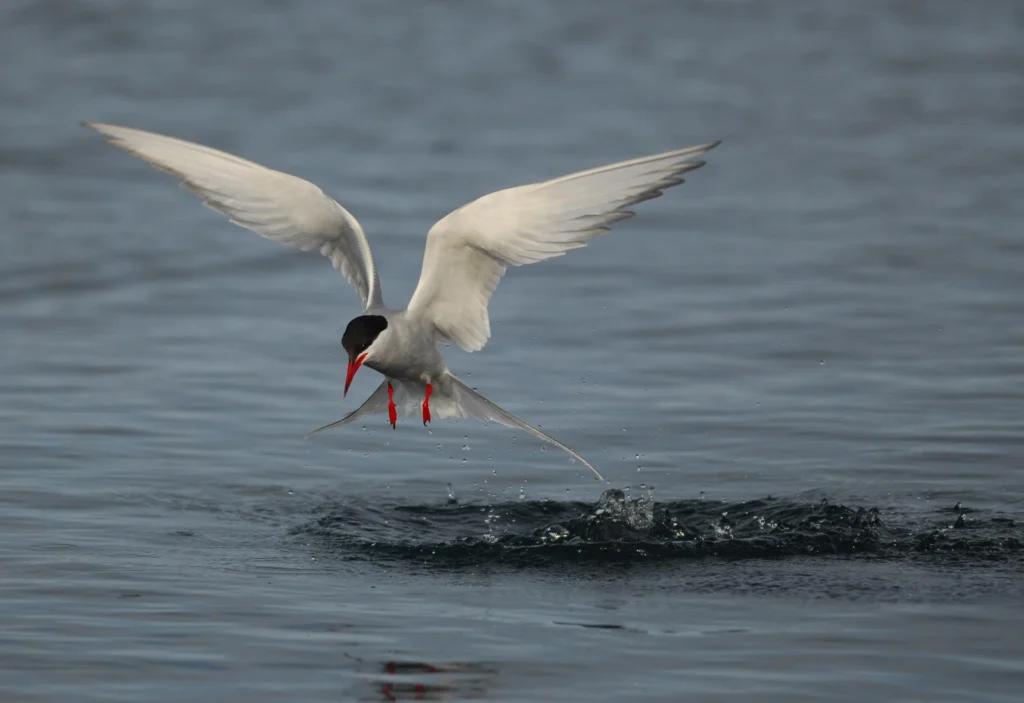

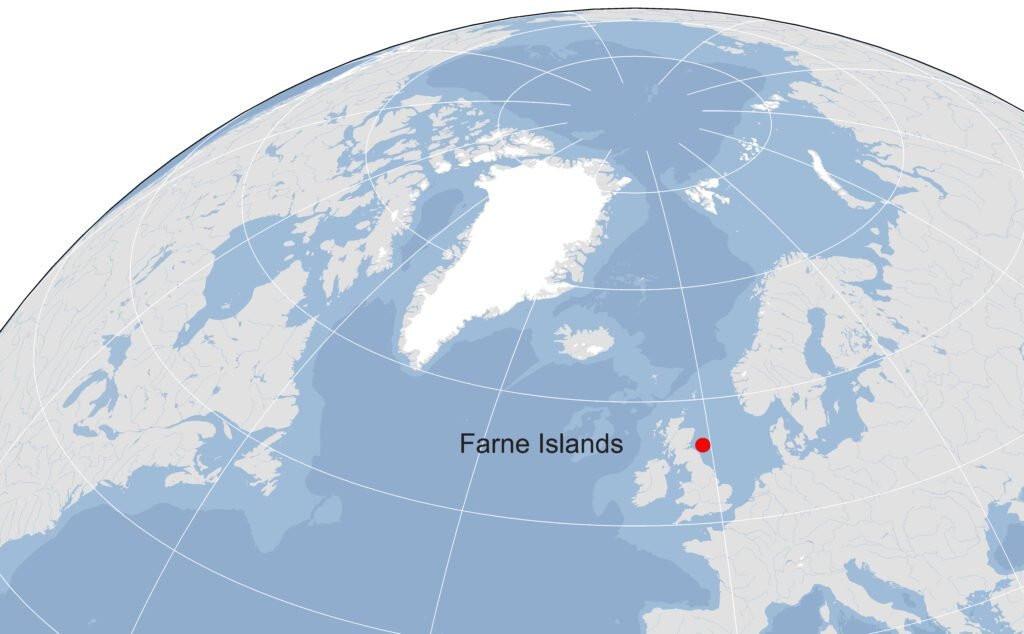
The Farne Islands archipelago of 15 to 20 islands, depending on the state of the tide, lies from 3.5 km off Northumberland along the north-east coast of England, UK. The islands fall into two groups, separated by Staple Sound. Inner Farne is the largest of the inner group at around 6.5 ha (equivalent to a square with sides of 255 metres), but is joined to Knoxes Reef and the Wideopens at very low tides. Consisting of grassy plateaux surrounded by vertical stacks, cliff faces and ledges, the islands provide habitats free of mammalian predators for seabirds to breed and, together with the Grey Seal colonies, are unique for the diversity of breeding wildlife accessible to the public. The islands are a National Nature Reserve and Site of Special Scientific Interest, with additional protection afforded by being a marine Special Area for Conservation and marine Special Protected Area. People have visited and interacted with Farnes seabirds for centuries, often using the seabird colonies for food, but from the early 20th century the islands have been protected by the National Trust (NT), with public access limited to three islands: Inner Farne, Staple Island and Longstone. NT Rangers have lived and worked on the main islands during the breeding season since 1971 to monitor and ensure security of the seabird colonies. Inner Farne, the largest of the Farne Islands, annually receives nearly 50,000 visitors who are constrained by low-mesh fences to specific paths and boardwalks where they can observe breeding Arctic Terns Sterna paradisaea and other seabirds.
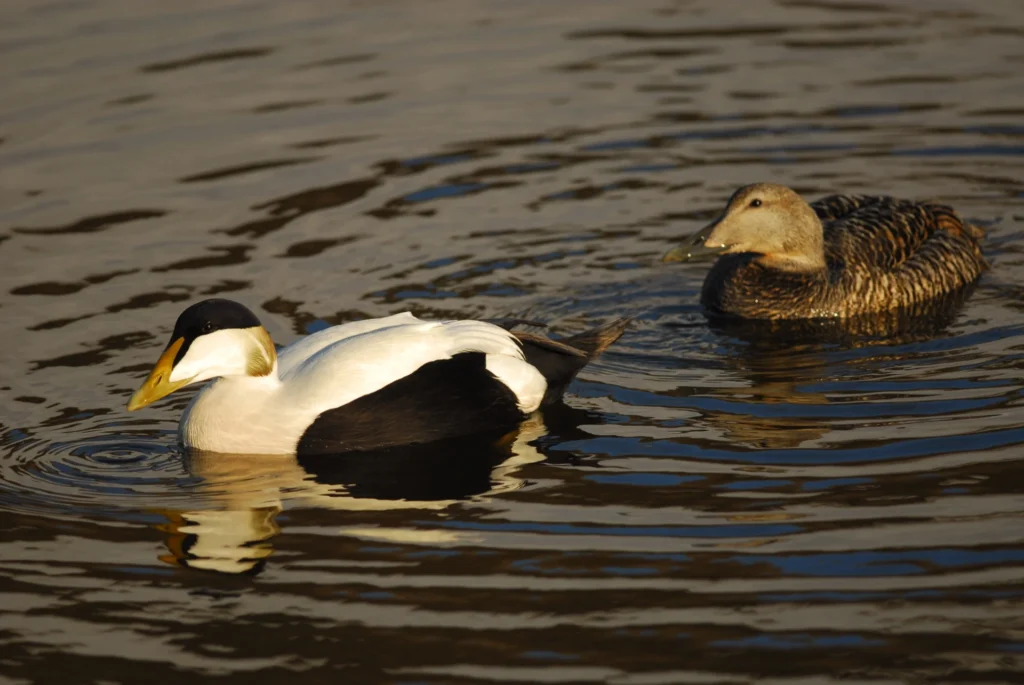
This is perhaps the best place in the world to view and enjoy breeding seabirds at close quarters. On Inner Farne, breeding Puffins (> 14,000 pairs), Guillemots (> 15,000 individuals), Razorbills (>200 pairs), Kittiwakes (>1500 pairs), Eiders (> 200 females), Common Terns (a few pairs), Arctic Terns (> 500 pairs) and Shags (150 pairs) can be watched from close distances – in some cases less than a metre – but usually within three or four metres. Other seabirds, not nesting as close to the boardwalks, are Black-headed Gulls, Sandwich Terns and Fulmar. On some of the other islands, Cormorant, Herring Gulls, Lesser Black-backed Gulls and Great Black-backed Gulls also breed, although the large gull species make themselves rather less welcome by predating the eggs, chicks and adults of other seabirds.
The visiting public and Rangers that live on the islands during the breeding season, are part of the Farnes ecology, helping to maintain the diversity of breeding seabirds by discouraging avian predators, such as the large gulls. On Inner Farne, Arctic Terns nest in close association with Ranger accommodation, the boardwalks and visitor access routes and also breed in various enclosed areas associated with human habitation and activity which has been a significant factor in the success of the Arctic Tern colony on this island.
Seabird research on the Farne Islands is supported by the Natural History Society of Northumbria and carried out in collaboration with the National Trust. The monitoring work carried out by the Rangers for more than 50 years has a significant impact in helping to interpret trends and manage the islands for its breeding seabirds and seals. As a result, these islands provide a unique wildlife experience which benefits people, birds and marine mammals.
Seatrack partner

Catherine Scott
Natural England

Chris Redfern
Newcastle university
Data availability